New app designed to help Arkansans struggling with opioid addiction


ARKANSAS, USA — The Arkansas Opioid Recovery Partnership (ARORP) launched a new cellphone app focused on helping people dealing with addiction.

The app is called ReviveAR and is designed to help with prevention, treatment and even recovery.

Among the features of ReviveAR, the app offers access to live written and audio instructions on administering the life-saving drug, Naloxone, if someone around you is experiencing an overdose. It also allows you to call 911 directly from the app.

Officials said students reported feeling less anxious in a situation like this when using the app, saying “they have an easy to use app with so many resources right at their fingertips.”

The instructions are offered in English and Spanish with Marshallese “coming soon,” the website said.

In addition to this, the app also offers access to

  • Support for struggling families
  • Instructions for safely disposing, monitoring or securing medications
  • Find local prevention treatment and recovery resources.

According to ReviveAR, “The app is targeted towards all Arkansans,” explaining that to make progress fighting the opioid crisis, “we need to increase the capacity of Arkansans to prevent, teat and recover from opioid use and opioid use disorders.”

The app is available to download in the Apple Store or Google Play. For more information on the app, click here.

Arkansans Dispose of 23,678 Pounds of Unwanted Medications on Drug Take Back Day

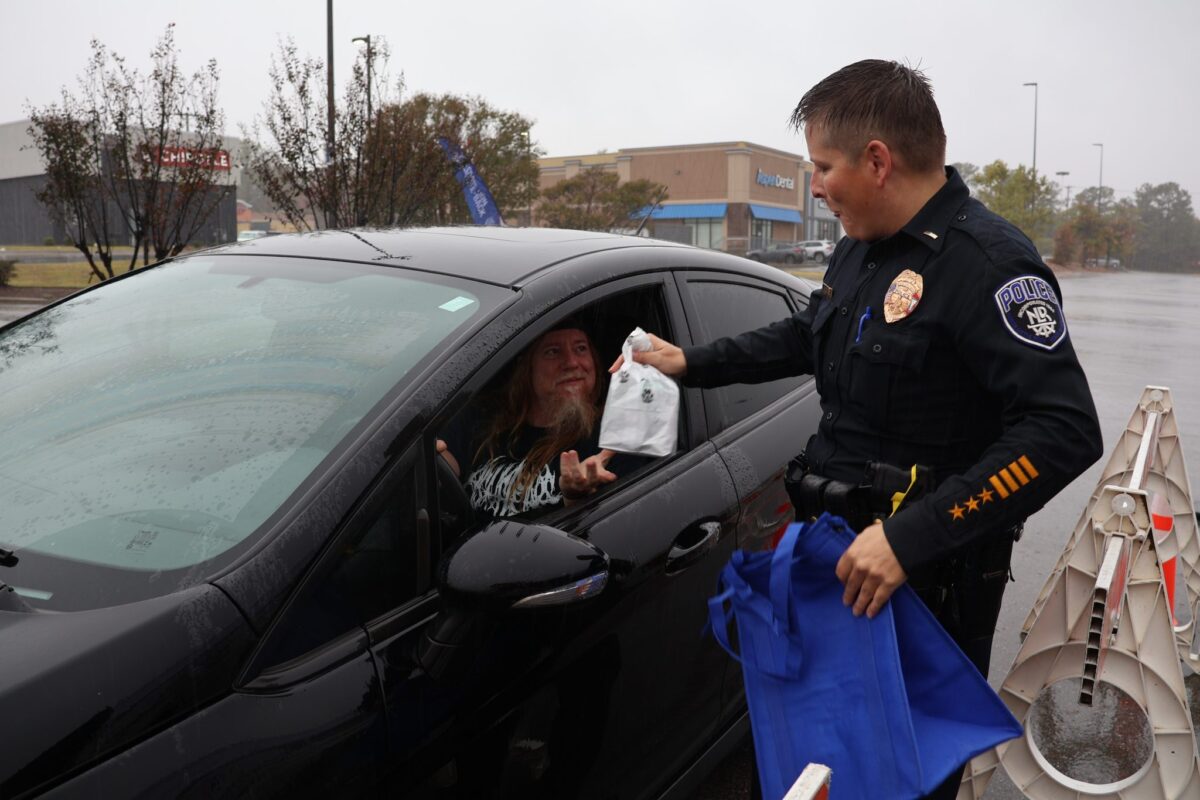
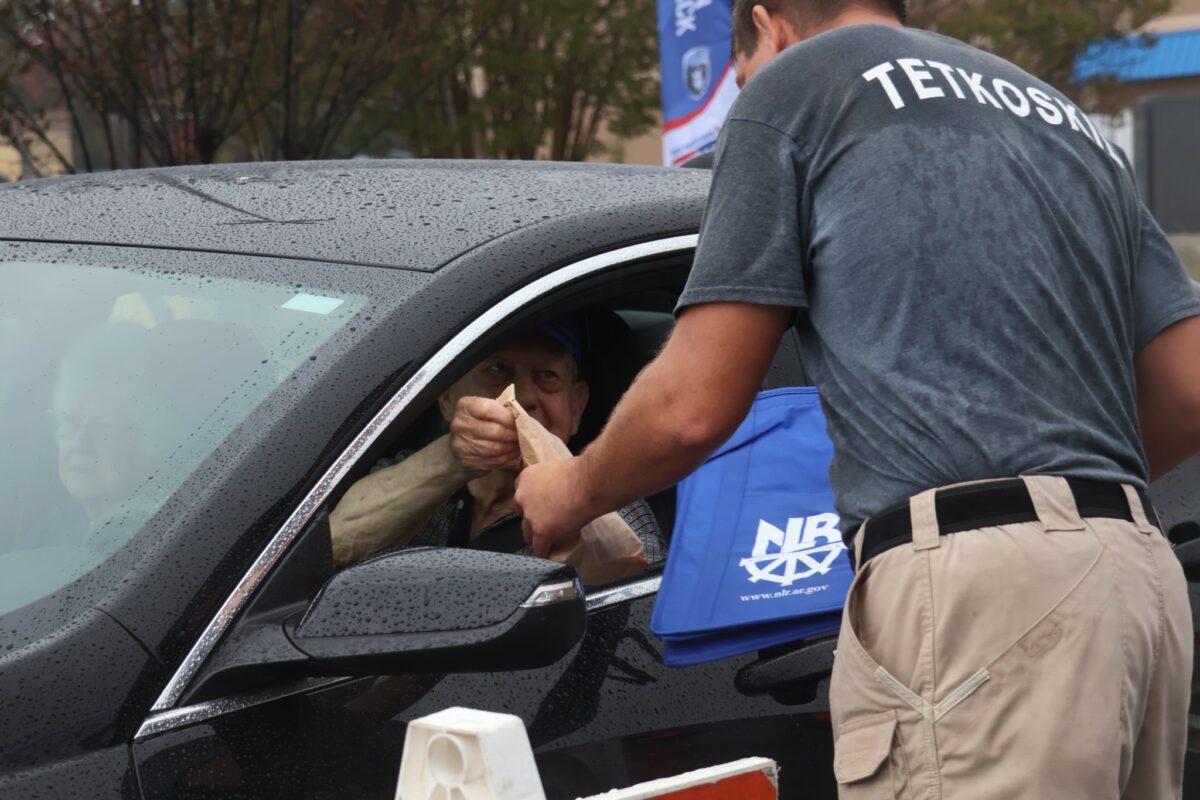
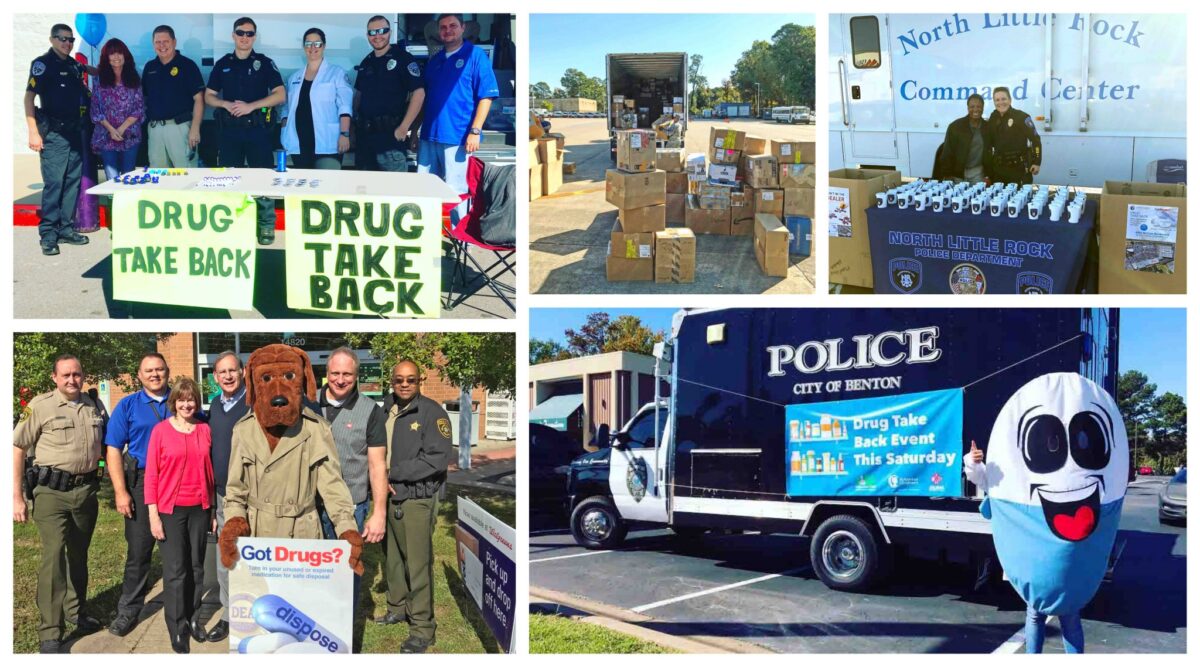
LITTLE ROCK, Ark. (Nov. 3, 2023) – Last Saturday, October 28, Arkansans braved rain and thunderstorms to “Drop it in the Box” by bringing 23,678 pounds (11.8 tons) of unwanted prescription drugs to over 275 Take Back boxes located around the state. The Drug Enforcement Administration (DEA) and the Arkansas National Guard ensured these medications were safely destroyed, keeping prescriptions out of the wrong hands and out of our water supply.

“According to the Centers for Disease Control and Prevention, the leading cause of death for 18-45 year-olds is drug poisoning. The CDC estimates 110,757 Americans lost their lives to drug poisoning last year,” said DEA Assistant Special Agent in Charge Jarad Harper. “There is a call to action in Arkansas to save lives and the DEA appreciates our state and local partners who help collect unwanted and unneeded prescription medications from the homes of Arkansans. We make the biggest impact working together, and with the ultimate goal of saving lives, we can make a difference in Arkansas and beyond.”

The Arkansas Drug Take Back was developed in 2010 to help Arkansas families secure, monitor, and dispose of their unwanted, unused, or expired prescription medications. The Arkansas Opioid Recovery Partnership (ARORP)’s www.ardrugtakeback.org provides additional educational resources and permanent Drug Take Back box locations.

“The Arkansas Drug Take Back has been a tremendous educational program,” said ARORP Director Kirk Lane. “Arkansans must monitor their homes, secure medications, and dispose of prescriptions that are no longer needed. Take Back provides an environmentally sound service to safely dispose of unwanted, unused, or expired medications and dangerous substances. The 571,899 pounds of medication destroyed since the program’s start is a tribute to Arkansans, local, state and federal law enforcement , and long-time Arkansas Drug Take Back partners who continue to make this evidenced-based program successful in keeping our communities safer.”

“Despite the inclement weather, Arkansans showed up in staggering numbers,” said Arkansas Drug Director Tom Fisher. “Our law enforcement and communities across the state partnered to prevent unused or expired medications from falling into the hands of potential victims or situations for prescription misuse. Thank you to the DEA, ARORP, Arkansas National Guard, UA Little Rock Midsouth, and the Department of Human Services Substance Use Prevention team for their hard work and dedication in the mission to prevent overdoses across the state.”

The next Take Back Day will be held in the spring of 2024. In the meantime, do your part by bringing unneeded drugs to a permanent Take Back box site. Please see www.ardrugtakeback.org for more information.

# # #

UAPD announces best ever drug take back event

Posted: 

Updated: 

FAYETTEVILLE, Ark. (KNWA/KFTA) — The University of Arkansas Police Department announced today that its recent drug take back event was its best ever.

UAPD made the announcement in a Facebook post on Nov. 2.

The post says that the event, which occurred on Oct. 28, yielded just over 13 pounds of unused or expired medications.

When paired with the amount accumulated since the last drug take back event, UAPD has collected nearly 52 pounds of medications.

“This is a massive step toward a safer and healthier community,” the post said.

Drug Take Back Day keeps drugs out of young hands, DEA says

by Lori Dunn | October 27, 2023 at 11:00 p.m. | Link to article

The Drug Enforcement Agency’s National Drug Take Back Day is one way the agency attempts to keep prescription drugs out of the wrong hands.

Twice a year, in April and October, the agency designates specific days for people to go through their medicine cabinets and turn in any unused or expired medications they may have.

Since its inception in 2010, the bi-annual event has removed more than 17 million pounds of unnecessary medications from communities across the country, according to a news release from DEA.

In April of this year, Arkansas collected 26,042 pounds of drugs from 122 collection sites. In October, Arkansas collected 26,935 pounds from 148 collection sites, according to the DEA.

Texas collected 47,695 pounds from 225 collection sites in April and 46,668 pounds in October, according to the DEA.

Nationwide, 663,725 pounds of unneeded medications were collected at nearly 5,000 collection sites, according to the DEA.

The agency is hopeful the drug take back days make it harder for people, especially teens and children, to access prescription drugs easily.

Most young adults who abuse prescription drugs get those substances from friends’ and families’ homes, according to the DEA. Recent data shows that overdose deaths in children under the age of 12 have been increasing along with the opioid crisis. When medications are left uncovered, children also risk accidentally ingesting opioids left around the house.

The Arkansas Opioid Recovery Partnership supports the DEA in its Drug Take Back Day.

“Since Drug Take Back’s start, Arkansas has safely collected and destroyed over 548 thousand pounds of unwanted, expired medications in an environmentally safe way, said Director Kirk Lane.

“Most importantly, the program has always been an educational program teaching citizens about the concept of monitor, secure and safely dispose,” he said.

There are also environmental impacts to improperly disposing of prescription drugs.

Old drugs that are flushed down the drain can end up in drinking water. Prescription drugs can’t be flushed or discarded into the trash. If thrown away whole, those drugs may be taken out of the garbage. Sometimes, people disguise drugs by mixing them into kitty litter or coffee grounds. However, those drugs seep into the earth, again finding their way into a water supply, according to the DEA.

Complete results for DEA’s spring National Prescription Drug Take Back Day are available at Take Back Day (dea.gov).

Print Headline: Drug Take Back Day keeps drugs out of young hands, DEA says

What to Do With Your Unused Prescription Drugs

by Little Rock Soirée Staff on October 24, 2023 | Link to original article

Do your part to safely dispose of prescriptions by participating in National Prescription Drug Take Back Day this Saturday, Oct. 28.

Held twice a year, the day is a chance to let the public properly dispose of their unused, unwanted or expired prescriptions while learning more about the opioid epidemic. In April, Arkansans brought in more than 26,000 pounds of medications, more than Alabama, Louisiana and Mississippi combined, according to the DEA.

Not only does disposing of old prescriptions help keep medicines from getting into the wrong hands, but it also keeps toxic waste out of places it shouldn’t be. A recent study shows 80% of U.S. streams contain trace amounts of human medicines, which cannot be removed by sewage systems, meaning they will eventually be released into lakes, rivers and oceans.

According to the Arkansas Drug Take Back website, the safest way to get rid of medicines is by high-temperature incineration at properly permitted facilities.

So how can you help? The organization has mapped out permanent drug collection sites across the state. Click here to explore the map and find a year-round site near you, and check out these Oct. 28 events from 10 a.m. – 2 p.m.:

  • Remedy Drug Rx, 8511 W. Markham St.
  • Park Plaza Mall, 6000 W. Markham St.
  • Kroger, 14000 Cantrell Road
  • The Pharmacy at Wellington, 15400 Chenal Pkwy., Ste. #100
  • Edwards Food Giant, 20383 Arch St.
  • Walmart, 8801 Baseline Road
  • McCain Mall, 3929 McCain Blvd., North Little Rock

For more info, head to the Arkansas Drug Take Back website or check it out on FacebookX (formerly Twitter) or Instagram.

CPD to host Drug Take Back Day event

By Kolton Rutherford | Link to original article by Log Cabin Democrat

The Conway Police Department (CPD) will host two drop-off locations for National Drug Take Back Day from 10 a.m. to 2 p.m. Saturday at the department’s headquarters at 1105 Prairie St. and Sam’s Club at 1250 S. Amity Road.

Billed as a “safe and responsible way for individuals to dispose of their unused, unwanted or expired prescription medications,” the CPD said the service is free and anonymous in a social media post. While medications will be accepted, officers will not be able to accept used needles.

Local law enforcement and the Drug Enforcement Agency are hosting similar events across the state on Saturday. In a news release issued Monday, the Arkansas Opioid Recovery Partnership said 275 take back boxes will be available across the state on Saturday.

“In 2021, over 107,000 people died of a drug overdose in the United States, which is almost 300 people a day,” the news release read.

Partnership director Kirk Lane said “most young adults who misuse prescription drugs get them from the home of a friend or family member.”

“Practicing the concept of secure, monitor and safely dispose keeps our families and communities safe,” Lane said.

The event was first devised in 2010 and has led to some 274 tons of medications being destroyed. Over 275 take back boxes are available every day of the year.

Arkansas Scarce of Medical Professionals With DEA Waiver Despite Increasing Need (Here’s How To Get A Waiver)

There’s less than 100 medical professionals (Physicians, Physician-Assistants, Nurses, etc.) in Arkansas, but the rate of substance abuse addiction continues to rise.

“Arkansas has a real need for medical professionals to have the ability to provide medication-assisted treatment,” said Arkansas Drug Director Kirk Lane.  “There are so few in this state who have a DEA waiver and we need to change that. Our overall goal is to save lives from the thrall of addiction and this can be another step toward accomplishing that important task.”

To apply for a DEA waiver to prescribe or dispense buprenorphine under the Drug Addiction Treatment Act of 2000, click here.

Drug Take Back Day Totals Exceed 26,000 Pounds

More than 26,000 pounds of prescription medications were collected during the Oct. 27, 2018, Arkansas Drug Take Back Day.

“The Prescription Drug Take Back days are an important piece of my collaborative approach to combatting the opioid crisis,” said Arkansas Attorney General Leslie Rutledge. “By safely disposing of more than 26,000 pounds of old, expired or unused prescription medications we are ensuring these lethal drugs are kept off the streets and out of the hands of our friends and neighbors.”

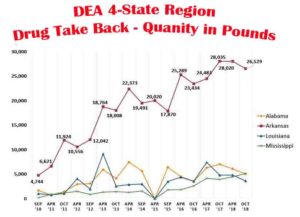
DEA’s New Orleans Field Division (NOFD), which covers Louisiana, Mississippi, Alabama and Arkansas, collected 40,307 pounds—over 21 tons of potentially dangerous expired, unused and unwanted prescription drugs for disposal at collection sites throughout the division. The amounts collected for each state within the NOFD was the following: Louisiana – 3,615 pounds; Mississippi – 5,113 pounds; Alabama – 5,050 pounds; and Arkansas – 26,529 pounds.

“The people of the state of Arkansas should be proud of their efforts during the recent Drug Take Back which resulted in the collection and destruction of 26,529 pounds of potentially dangerous, expired, unused and unwanted prescription drugs,” said DEA Assistant Special Agent in Charge Justin King. “Arkansas continues to lead other states in the region in the volume of drugs collected during Take Back, which is a testament to the outstanding efforts of everyone involved. We would like to thank everyone who participated in this critical event which makes our homes and communities safer, while raising awareness of the opioid epidemic threatening the people of Arkansas.”

As part of the “Monitor, Secure, and Dispose” effort, the coalition organized Arkansas’s participation in the U.S. Drug Enforcement Administration’s National Prescription Take-Back Initiative, and take back events took place on September 25, 2010, April 30, 2011, October 29, 2011, April 28, 2012, September 29, 2012, April 27, 2013, October 26, 2013, April 26, 2014, and September 27, 2014. DEA announced the discontinuation of the national initiative in September 2014, but an Arkansas take back event under the leadership of partners within the state was held on April 25, 2015. DEA then reinstated the program nationally, and events since have been held on September 26, 2015, April 30, 2016, October 22, 2016, April 29, 2017, October 28, 2017, April 28,2018, and October 27, 2018.

[DISCLAIMER: **Collectively, there have been 17 total Arkansas prescription drug take back events: one local and 16 national events. Results from the State Take Back in Spring 2015 were rolled into the total results for National Take Back 10 held September 26, 2015.]

Due to the commitment, dedication, and effort of the Arkansas Law Enforcement Community, its partners, and the multi- agency coalition, and due to excellent participation by Arkansans in all areas of the state, the take back events have been successful above and beyond all expectations. Altogether, the 16 Prescription drug take back events have produced the return of almost 160 tons of unneeded medications, estimated at 442.6 million pills.

STATISTICAL INFORMATION:

Including all 16 events:

  • Arkansas ranks #3 nationally in pounds collected per capita with 106 pounds per person, just barely behind Wisconsin with 0.112 pounds per person and Maine with 0.264 pounds per person.*
  • Despite being just thirty-third in population among all states, Arkansas ranks #14 in total weight
  • Arkansas averaged 68 more law enforcement agencies per event than the national
  • Also, per event, Arkansas averaged 194 collection sites – the national average per state was 123 per

The four-state DEA region consisting of Alabama, Arkansas, Louisiana, and Mississippi pooled a total weight of 482,357 pounds for all 16 Take Arkansas, despite being the least populated of the four: accounts for 66% of the total weight, collecting 154,049 pounds more than the other three states combined; averages more participating law enforcement agencies than the other three states combined; and, accounts for 50% of the region’s total sites for Take Back

For Take Back 16, only:

Arkansas ranks #13 nationally in weight collected, and ranks 5th per capita. Maine ranks #1, followed by Wisconsin, Vermont and New Hampshire,

Arkansas ranks 15th in the number of registered collection sites (168) and 9th in the number of participating law enforcement agencies (181) .

* Determined using 2017 census estimates.

The Cost of Crisis: Battling Opioid Addiction in Arkansas

By Eric Francis | Photography by Jamison Mosley (AMP: Arkansas Money & Politics)

How expensive is the opioid crisis? Good question. The pills can be $80 on the street, the overdose remedy $125 per application and treatment programs up to $14,000 a year. But as yet, nobody can accurately quantify how much opioid addiction is costing Arkansas.

In 2017, it cost the North Little Rock Police Department nearly $4,800 to prepare its officers to deal with opioid overdoses: $4,000 for Narcan kits and CPR equipment, plus the policing hours lost while officers were in training.

For 2018, that figure jumped 400 percent, to $27,000.

“We’ve trained everybody in the department twice now on the use of Narcan, and they’re all recertified in CPR training, and all of that is because of the opioid issue,” says North Little Rock Police Chief Mike Davis, who’s been with the department more than 20 years. “We bought Narcan kits for the fire department, as well, so all their trucks would have it.”

This year’s expenses included 180 Narcan kits at $125 apiece, which were paid for through a grant, as well as about 150 hours of training time for the officers who recertified the force in CPR and taught how to administer Narcan, a drug that temporarily counteracts the effects of an opioid overdose so there is more time to get the person medical care.

Of course, in the big picture, $32,000 over two years isn’t going to break the bank of a sizable police department. But the economic repercussions of the opioid crisis in Arkansas are far-ranging, according to State Drug Director Kirk Lane.

RELATED: Opioids in Arkansas

“I call it the economics of addiction,” says Lane, who was Benton’s police chief before Gov. Asa Hutchinson tapped him for his current post last year.

The opioid addiction crisis has its roots in prescription painkillers like oxycodone and hydrocodone (prescribed as OxyContin and Vicodin, respectively), among others. Patients who are prescribed these drugs can develop a dependency that builds into a habit of taking anywhere from a few to dozens of pills a day, Lane says.

Where are those pills coming from? Well, in 2016, Lane notes, about 235 million opioid pills were prescribed in the state of Arkansas. That was enough to give almost 80 to every one of Arkansas’ 3 million residents.

“Drugs on the street are worth about a dollar a milligram, so hydrocodone is about $30 a pill on the street and OxyContin would be $80,” he says. “Go back to what I say about having a 10 to 40 pill a day habit, and that’s how much money you’ve got to come up with.”

That’s thousands of dollars a day, in some cases, that’s being taken out of the legal economy and funneled into the illicit drug market, Lane notes. And the costs keep accumulating even if an addict seeks treatment.

“Rehabilitation, treatment, recovery insurance – there’s all kinds of financial factors that go into the way this opioid problem is impacting us,” he says. “There’s lots of different facets to this problem economically, when you look at it, from health care to Medicaid, insurance costs to incarceration and law enforcement expense.”

Yet, Lane cannot put a dollar figure on the total economic impact of the opioid crisis in Arkansas.

Opioid

“We’ve trained everybody in the department twice now on the use of Narcan, and they’re all recertified in CPR training, and all of that is because of the opioid issue.” North Little Rock Police Chief Mike Davis

“One of the problems we have in Arkansas is we don’t have strong data,” he says. “We were very slow to develop this [reporting] process compared to other states, mainly because we have such a large methamphetamine problem and because prescription pills are so available. We are just now starting to get grants to develop a better picture of what’s going on in the state so we can answer those questions.”

He can, however, place a dollar figure on what the state has been spending to combat the epidemic. In the 14 months since he was appointed to the post, Lane’s office has received more than $40 million in federal grants for its efforts around the state.

“A couple of weeks ago, we got $22.6 million from three grants to put into prevention and treatment programs, Narcan programs,” he says. “So, over the next two to five years, you’re going to really be seeing those programs grow.”

Spread those grants over five years, and that’s about $4 million per annum in spending. But the cost of dealing with opioid addiction can be staggering. The National Institute on Drug Abuse has estimated that the cost of treatment can range from $6,500 per year for a methadone-based program to more than $14,000 per year for one using naltrexone, both of which are used to abate the effects of opioids, so addicts have a chance to break the habit.

So, does Lane think $4 million a year would be enough to mount an effective offensive against opioids? He is hesitant to say.

“It’s hard for me to talk about dollars because the first thing we have to have is buy-in from all the stakeholders,” Lane says. “The medical community is stepping up to the plate on education and curbing prescription habits, and they’re curbing that slowly. For victims or patients, [there needs to be] varied types of funding whether it be Medicaid, self-insurance, or programs for that, too, through these federal grants.”

Meanwhile costs filter outward into areas beyond policing and treatment expenses. Judge Randy Morley of North Little Rock Municipal Court says while most opioid possession and distribution cases are felonies handled in circuit court at the county level, he still sees ripple effects in code enforcement cases.

RELATED: Guest Column: Reducing Opioid Deaths Will Take All of Us by Kirk Lane

“From an economic standpoint, what I see is an exacerbation of lower income problems because those are the ones who end up in my court on code enforcement,” Morley says. “These folks, they don’t have any money and the only teeth I have is to fine them, but they can’t pay the fines.”

Morley speculates that what those people need most is better social services. North Little Rock’s police chief is on the same page.

“From my perspective, it’s all about treatment,” Davis says. “Pour the money into those kinds of things to stop this from getting worse.”

But services cost local governments money, of course. And Colin Jorgensen, litigation counsel for the Association of Arkansas Counties, says it’s unlikely most of the state’s counties have the resources to increase such offerings.

“[W]hile the epidemic increases demand for those services, at the same time, it has negatively impacted tax revenue due to lost productivity and declining labor forces and other economic impacts,” he says. “So most, if not all, counties would be unable to spend more money because there isn’t more money to spend.”

While the AAC doesn’t currently have a quantified list of how much is being spent by its member counties to address the opioid epidemic, that may soon change. Through the AAC and the Arkansas Municipal League, all 75 counties are pursuing a lawsuit against opioid manufacturers and distributors. During that lawsuit, they will investigate exactly what the economic impact of the epidemic has been on the counties, Jorgensen said.

Filed in Crittenden County Circuit Court, the suit seeks unspecified damages, to include “past damages and restitution for monies spent by the state, counties, and cities for those extraordinary and additional services which they would not have otherwise incurred but as a result of the Arkansas opioid epidemic and their past efforts to abate it.”

Whatever the outcome of that suit, Drug Director Lane believes that it’s going to take an increase in treatment to adequately address the crisis and reduce the costs that are being incurred across the fiscal spectrum.

“I think, economically, if we all do that and start working toward those ends, some of those cost factors will significantly go down from impact on crime and on families, social services, foster care, state services,” he says. “It would impact the state significantly for the better if we all accepted responsibility that, in essence, we all created that problem and we all need to work to solve it.”

RELATED: Read the digital issue
Arkansas Governor Issues Opioid Awareness Day Proclamation

Arkansas Governor Asa Hutchinson issued a Proclamation this morning making today (October 24, 2018) as the “Opioid Awareness Day in Arkansas.” Governor Hutchinson said the opioid epidemic is “One of the deadliest drug epidemics in American history, affecting every sex, race, class, and age” and that 1,893 people have died in Arkansas from a drug overdose since 2013. He also said that Arkansas has the second-highest opioid prescribing rate in the United States.

For the full proclamation click here.