270 Lives Saved By Arkansas Naloxone Project

270 -that is the number of lives saved by the Arkansas Naloxone Project, which provides first responders naloxone toolkits to reverse an opioid overdose. The best part of this statistic, aside from the lives saved, is that many of those survivors have either attended or attending substance abuse treatment facilities. Many of these survivors are now in recovery.

“Some feel that these people are unworthy of being saved,” Arkansas Drug Director Kirk Lane said. “It is important to understand that – If they are alive, there is a chance of recovery. We have met several of these saved individuals, and members of their family, and found that they are now in the process of going through recovery treatment because of these events. We hope that this project will reduce our fatality deaths during this epidemic, and help those with a substance abuse disorder a path towards recovery.”

3,640 – is the number of naloxone toolkits distributed to first responder agencies (and 7 school nurses) throughout the state provided by the Criminal Justice Institute (CJI) through a grant provided by the Blue & You Foundation for a Healthier Arkansas, Office of Arkansas Drug Director, and the Department of Human Services -Division of Aging, Adult, & Behavioral Health Services. Each naloxone toolkit recipient receives naloxone training through CJI. Among the items contained in a Narcan kit are two Naloxone nasal sprays, an opioid antagonist used to reverse the effects of an opioid-induced overdose.

“Our goal is to get the life-saving naloxone kits in the hands of all first responders in the state, which includes them completing a training program,” Lane said. “In the near future, we also want to distribute naloxone kits to various people in society. When a life is saved with naloxone, there is hope for recovery.”

Though it should be used in an emergency situation (a suspected opioid overdose), Naloxone has no effect on non-opioid overdoses. Naloxone is available for purchase at some pharmacies in Arkansas.

To reduce the morbidity and mortality of opioid overdoses in Arkansas, Arkansas Governor Asa Hutchinson has a standing order [Arkansas Code § 17-92- 101(16)] allowing Arkansas-licensed pharmacists to initiate naloxone therapy including ordering, dispensing and/or administering naloxone, along with any necessary supplies for administration, to eligible persons who are at risk of experiencing an opioid-related overdose, or who are family members, friends, or others who are in a position to assist a person at risk of experiencing an opioid-related overdose.

Arkansas is 1 of 40 states exercising the Good Samaritan Overdose Immunity Laws, which encourages people to seek out medical attention for an overdose or for follow-up care after naloxone has been administered. These laws generally provide immunity from arrest, charge or prosecution for certain controlled substance possession and paraphernalia offenses when a person who is either experiencing an opiate-related overdose or observing one calls 911 for assistance or seeks medical attention. For more information: http://www.ncsl.org/research/civil-and-criminal-justice/drug-overdose-immunity-good-samaritan-laws.aspx

****Be sure to checkout and download the Narcansas App here which has step by step instructions on how to administer naloxone. The nARcansas app is a free opioid overdose resource containing tools that will help you administer the drug naloxone in the moment of an opioid overdose and provide steps on how to save a person’s life in the event of an opioid overdose.

CHI St. Vincent Hosts Opioid Epidemic Discussion with Arkansas Drug Director

From CHI St. Vincent [www.chistvincent.com]

CHI St. Vincent Hosts Opioid Epidemic Discussion with Arkansas Drug Director

CHI St. Vincent welcomed Arkansas Drug Director Kirk R. Lane to discuss the state of Arkansas’ opioid epidemic with medical staff on Friday, July 19. Lane’s presentation, entitled “Arkansas Opidemic,” emphasized that the opioid problem in Arkansas is among the worst in the country and far more endemic than many believe. He also highlighted to role medical professionals must play to help address this challenge.

“The ‘Opidemic’ in Arkansas is gaining momentum with the influx of synthetic opioids such as fentanyl seeping into an opioid-dependent population,” said Lane, who was appointed by Governor Asa Hutchinson in 2017 to lead efforts to reduce opioid abuse and overdose deaths. “We need to have an ‘all in approach’ led by our medical professionals to turn this momentum around. Knowing what the issues are through education will lead us in the right direction to make a difference and save lives.”

CHI St. Vincent continues to develop programs to help educate patients, provide alternative pain management options and support those who may be suffering from opioid addiction. That includes coordinating with the Arkansas Department of Human Services to have peer recovery specialists on call at CHI St. Vincent Infirmary in Little Rock and CHI St. Vincent North in Sherwood. In June, CHI St. Vincent Hot Springs hosted a summit to kick off a drug overdose prevention program targeting opioid abuse in Garland County.

“The opioid epidemic in Arkansas is far worse than many of us can imagine. Too many are quietly suffering from opioid addiction that impacts not only their lives, but also the lives of friends, family and others around them.” said Dr. Gerry Jones, CHI St. Vincent Vice President of Medical Affairs for Central Arkansas. “CHI St. Vincent remains committed to helping protect our children and all Arkansans from this insidious epidemic as part of our healing ministry and work to create healthier communities.”

Lane’s presentation was part of the CHI St. Vincent Grand Rounds Lecture Series. The monthly series offers physicians, APRNs and nursing staff the opportunity to review and discuss the latest developments in health care, share research highlights, learn best practices and collaborate on improving care for patients.

ARKANSAS DRUG TAKE BACK DAY: NINE YEARS LED TO 173 TONS OF MEDICATIONS COLLECTED

Since the summer of 2010, Arkansas has collected 173 tons of medications from Drug Take Back Day events. Although Arkansas is 33rd in population, the state ranks 3rd nationally in pounds collected per capita and 13th in total weight collected.

The 17th Drug Take Back Day, which was held on April 27, 2019, resulted in a total medications collection of 469 tons nationally, and 14.43 tons of that came from Arkansas. The state ranks 5th in the number of Drug Take Back Day collection sites with 310 and ranks 10th in the amount of law enforcement agencies participating in the semi-annual Drug Take Back Day with 184.

Arkansas has consistently led the four-state DEA region (Alabama, Arkansas, Louisiana, and Mississippi) accounting for 63% of all the medications collected. Arkansas also averages more participating law enforcement agencies than the other three states combined.

Arkansas Drug Take Back Day History

The Office of National Drug Control Policy (ONDCP), as part of its National Drug Control Strategy, called for an increase of prescription drug return and disposal programs as a means to curbing prescription drug abuse. In early 2010, a coalition led by the State Drug Director, the Attorney General, both Arkansas Districts of the U.S. Attorney’s Office, and numerous federal, local, and state agencies, prevention professionals, and private organizations, launched an ongoing education program to encourage everyone to “Monitor, Secure, and Dispose” their prescription medications.

As part of the “Monitor, Secure, and Dispose” effort, the coalition organized Arkansas’s participation in the U.S. Drug Enforcement Administration’s National Prescription Take-Back Initiative, and take back events took place on September 25, 2010, April 30, 2011, October 29, 2011, April 28, 2012, September 29, 2012, April 27, 2013, October 26, 2013,  April 26, 2014, and September 27, 2014. DEA announced the discontinuation of the national initiative in September 2014, but an Arkansas take back event under the leadership of partners within the state was held on April 25, 2015. DEA then reinstated the program nationally, and events since have been held on September 26, 2015, April 30, 2016, October 22, 2016, April 29, 2017, October 28, 2017, April 28, 2018, October 27, 2018, & April 27, 2019.

[DISCLAIMER: **Collectively, there have been 18 total Arkansas Drug Take Back Day events, and 17 national events. Results from the State Take Back in Spring 2015 were rolled into the total results for National Take Back 10 held September 26, 2015.]

Due to the commitment, dedication, and effort of the Arkansas Law Enforcement Community, its partners, and the multi-agency coalition, and due to excellent participation by Arkansans in all areas of the state, the take back events have been successful above and beyond all expectations.

The 17th Drug Take Back Day resulted in a total medications collection of 469 tons nationally and 14.43 tons in Arkansas. The grand total of all Drug Take Back Day events have resulted in 11,228 tons nationally and 173 tons in Arkansas.

STATISTICAL INFORMATION – National Comparison:

Including all 17 events:

Arkansas ranks #3 nationally in pounds collected per capita with 0.115 pounds per person, behind Maine with 0.285 pounds per person and Wisconsin with 0.122 pounds per person.1

Despite being just thirty-third in population among all states, Arkansas ranks #13 in total weight1

Arkansas ranked 10th in the amount of law enforcement agency participation with 184. Texas ranked 1st with 380 agencies. Washington D.C. ranked last with 1 agency. Nationally there were 5,015 agencies (average of 162 per state).2

Arkansas ranked 5th in the number of collection sites with 310. Texas ranked 1st with 380 and North Dakota was last with 3.

The 4-state DEA region consisting of Alabama, Arkansas, Louisiana, and Mississippi pooled a total weight of 46,459 pounds for the 17th Drug Take Back Day and 528,816 pounds for all 17 Drug Take Back Day events. Arkansas, despite being the least populated of the four: (1) Accounts for 52% of the total weight, collecting 165,310 pounds more than the other three states combined; (2) Averages more participating law enforcement agencies than the other three states combined;2 and; (3) Accounts for 63% of the region’s total sites for Take Back 17.

For Take Back 17, only:

Arkansas ranks #13 nationally in weight collected (#1-#12: California, Texas, Wisconsin, New York, Illinois, Pennsylvania, Ohio, Missouri, Maine, Florida, Massachusetts, & Virginia)

Ranks 5th per capita. Maine ranks #1, followed by New Hampshire, Vermont, & Wisconsin, respectively.

Ranks 5th in the number of participating Law Enforcement Agencies.

Ranks 5th in the number of registered collection sites.

1 Determined using 2017 census estimates.  2 Determined using data supplied by the National DEA.

STATISTICAL INFORMATION – Local Comparison: 3

 Weight Collected Per Law Enforcement Agency (Take Back 17, only):

Pulaski County Sheriff’s Office ranked #1 with 3,960 pounds collected (14% of the state’s total)

Washington County Sheriff’s Office ranked #2 with 1307 pounds collected (4.5% of the state’s total)

Benton Police Department ranked #3 with 1,148 pounds collected (3.9% of the state’s total)

Baxter County Sheriff’s Office ranked #4 with 1110 pounds collected (3.8% of the state’s total)

North Little Rock Police Department ranked #5 with 976 pounds collected (3.3% of the state’s total)

The collection rate of this Take Back equaled 0.0088 lbs. per man, woman, and child in the state, or 8.8 pounds per 1,000 citizens, and, when compared to the population of each Judicial District, provided a baseline for collections. Judicial Districts who exceeded the baseline rate of 8.8 pounds per 1,000 citizens included the 4th Judicial District, 5th Judicial District, 6th Judicial District, 8th South Judicial District, 9th West Judicial District, 13th Judicial District, 14th Judicial District, 16th Judicial District, 18th East Judicial District, 20th Judicial District, 21st Judicial District, and the 22nd Judicial District.

3 Determined using data supplied by the Local DEA.

300+ DRUG TAKE BACK DAY LOCATIONS LED TO RECORD BREAKING DAY

In just one day, nearly 29 thousand pounds of prescription medications were collected from more than 300 locations across Arkansas, breaking the previous Arkansas Drug Take Back Day record.

“Community, business and law enforcement partnerships continues to grow immensely in Arkansas as more people are recognizing the true value of this program,” said Arkansas Drug Director Kirk Lane. “The Arkansas Drug Take Back Day isn’t just about collecting expired or unneeded medications; it’s an expanding opportunity to educate more people about the opioid epidemic in our state. It’s our goal to save lives and mold safer communities through addiction prevention measures such as this ultra-successful program.”

The theme of the 17th Arkansas Drug Take Back (held on April 27, 2019) was “I can. You can. We can. Save a life with Narcan!” to coincide with the launch of the nARcansas app – a free resource containing tools to administer naloxone, an opioid antagonist, in the moment of an opioid overdose and continued steps to save a person’s life. Though it should be used in an emergency situation only, Naloxone has no effect on non-opioid overdoses.

Lane said the announcement of the nARcansas app launch during this Arkansas Drug Take Back Day will lead to numerous lives being saved.

“We’ve handed out thousands of Naloxone kits with training to Arkansas first responders who in turn, to date, have saved 246 lives,” Lane said. “Expanding the training to the rest of the public with just the touch of a finger on a cell phone can lead to immeasurable lives being saved in the near future. It also gives a multitude of resources including links to treatment centers, prevention information, and much more.”

The culmination of the 17th Arkansas Drug Take Back Day resulted in 28,860 pounds of medications collected.

“The DEA is pleased at the overwhelming response of the citizens of Arkansas, and we thank them for participating in this important event – making their homes and communities safe from possible prescription drug abuse or theft,” said DEA Assistant Special Agent in Charge Justin King.  “With the continued collaborative support and hard work of our state and local law enforcement and community partners, these Take-Back events have increased awareness of the opioid epidemic and offer our citizens a safe and anonymous way to dispose of unwanted and expired medications.”

Of the 310 locations designated as an Arkansas Drug Take Back Day site, 100 were event day sites only. That means there are 210 permanent drop box locations in Arkansas for people to continue disposing of medications, and many are accessible 24 hours. Each permanent drop box is designated to be emptied on a daily basis by law enforcement officers. Find a permanent drop box location near you at ArTakeBack.org and click the Collection Sites tab, type in the zip code, choose a distance and hit the filter tab.

Of the 137 law enforcement agencies, Pulaski County Sheriff’s Office collected the largest amount at 3,960.2 pounds. The Benton Police Department was second with 1,148 pounds and Baxter County Sheriff’s Office was third with 1110.5 pounds.

All the medications collected during the 17th Arkansas Drug Take Back Day, as were previous events, were transported via the Arkansas National Guard to a facility for environmentally safe destruction.

Prescription medicines are a toxic waste & pose a danger to people, pets, & the environment if they are not disposed of properly. Medicines flushed or poured down the drain end up in the waterways, affecting our drinking water. Throwing medications in the trash, even if they are mixed with materials such as kitty litter or coffee grounds, will still make it to a landfill and seep through the soil and into groundwater. There’s also a danger of people and/or pets finding medications in the trash – The Animal Poison Control Center said 17.5% (34,888) of pet poisoning calls in 2017 were attributed to prescription medications.

In Arkansas, there were 379 drug overdose deaths in 2016, which increased to 411 drug overdose deaths in 2017. Arkansas ranks second in the nation for per capita opioid prescriptions, at 107 per 100 residents; the national average is 58.7 prescriptions per 100 persons. In nearly a decade (since 2000) deaths involving opioids has increased by 200% in the U.S.

Two-thirds of teenagers & young adults who report abuse of prescription medications say they get the majority of the medications from friends, family & acquaintances.

  • DON’T leave medication bottles or pill cases lying around
  • DON’T store medicines in an unsecured medicine cabinet or bathroom drawer
  • DON’T ignore warning signs (Ex: bottles tampered with, pills missing or drugged behavior of someone in your home)
  • DO lock up medications in a lock box or hide them in a safe place
  • DO keep track of medications – count pills, make marks on liquid containers
  • DO keep track of refills – refilling medicine more often than expected can indicate a problem
  • DO encourage relatives, friends & neighbors to monitor medications & participate in the Arkansas Drug Take Back Day.


The nARcansas app was created in a partnership with the Office of Arkansas Drug Director, Criminal Justice Institute, Division of Aging, Adult and Behavioral Health Services and Team Si. Naloxone is available for purchase by the public at some pharmacies throughout Arkansas.

JOINING THE CAUSE: 15+ Walmart stores to host ‘AR Drug Take Back Day’ locations

A multitude of Walmart stores across Arkansas will host AR Drug Take Back Day sites in the effort to “End the Opidemic” that plaques the state.

The Arkansas Drug Take Back Day will be 10 a.m. – 2 p.m. Saturday, April 27 and will include more than 250 locations across the state. Hundreds of volunteers and first responders will be at those locations encouraging citizens to dispose of unused or expired medications and officers will not ask for any identification or other questions regarding the prescriptions being dropped off. For the list of all locations in Arkansas click here and here is the list of Walmart locations in Arkansas:

  • Conway:                        1155 Hwy 65 North
  • Sherwood:                    9053 Highway 107
  • Mountain Home:        65 Walmart Drive

  • Paragould:                   2802 W. Kings Highway

  • Springdale:                 2004 S. Pleasant Street & 3553 E. Robinson Avenue

  • Berryville:                   1000 W. Trimble Avenue
  • Searcy:                         3509 E. Race Avenue
  • Trumann:                    512 Industrial Park Drive

  • De Queen:                   926 E. Collin Raye Drive

  • Arkadelphia:              109 WP Malone Drive

  • Alma:                           367 W. Cherry Street
  • Fayetteville:                3919 No. Mall Avenue
  • West Helena:             602 Shelia Street
  • Bryant:                        400 Bryant Avenue
  • Greenwood:                551 Liberty Drive
The theme of the 17th Arkansas Drug Take Back Day, the theme is “I can. You can. We can. Save a life with Narcan!” with the introduction of the new nARcansas cell phone app! The nARcansas app is a free opioid overdose resource containing tools that will help you administer the drug naloxone in the moment of an opioid overdose and provide steps on how to save a person’s life in the event of an opioid overdose. Naloxone, an opioid antagonist, is a medication used to reverse the effects of an opioid-induced overdose. Though it should be used in an emergency situation only, Naloxone has no effect on non-opioid overdoses.
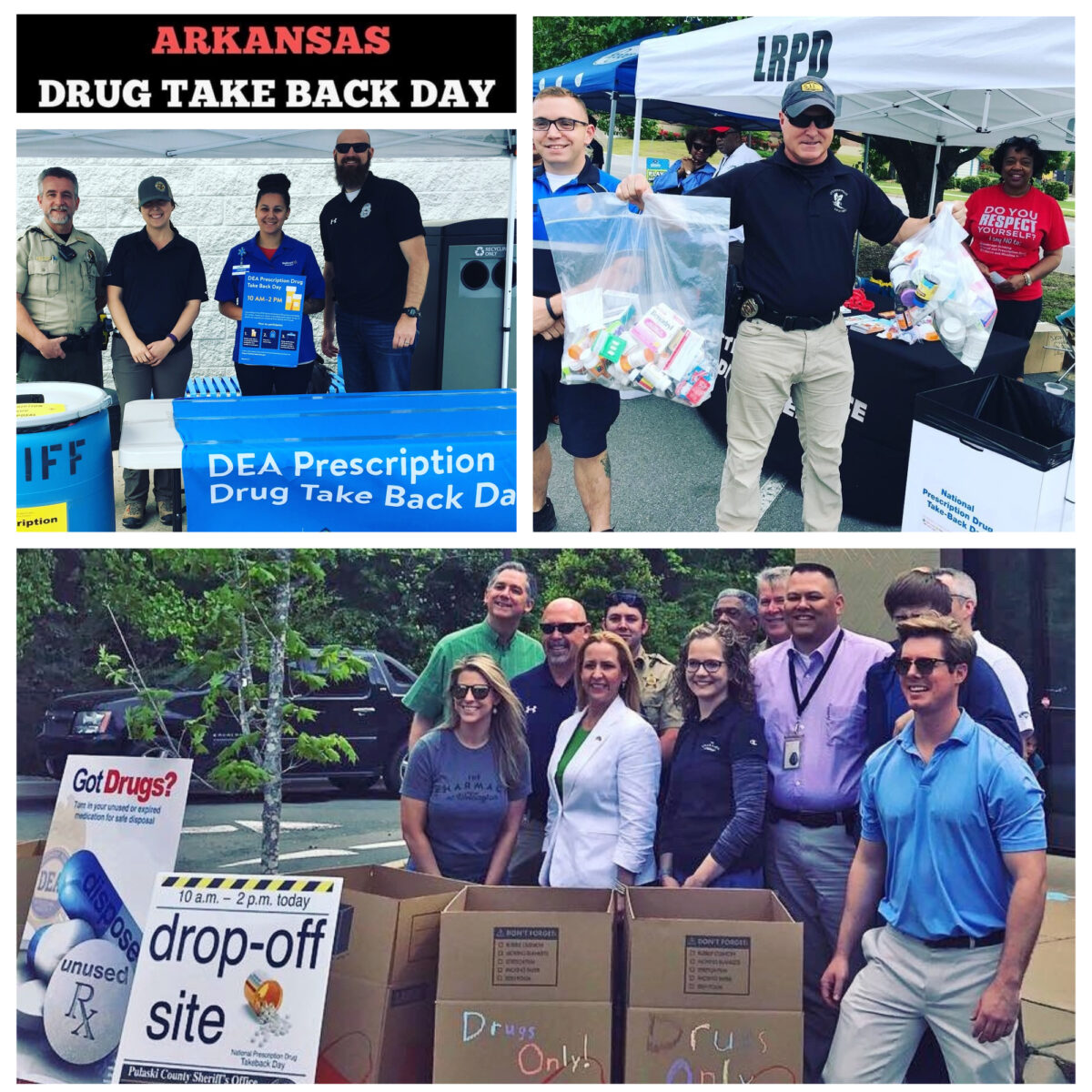
The prescription medications will later be counted for statistical purposes and destroyed at a facility in an environmentally safe manner. Prescription medicines are a toxic waste & pose a danger to people, pets, & the environment if they are not disposed of properly. Medicines flushed or poured down the drain end up in the waterways, affecting our drinking water.

Throwing medications in the trash, even if they are mixed with materials such as kitty litter or coffee grounds, will still make it to a landfill and seep through the soil and into ground water. There’s also a danger of people and/or pets finding medications in the trash – The Animal Poison Control Center said 17.5% (34,888) of pet poisoning calls in 2017 were attributed to prescription medications.

In Arkansas, there were 379 drug overdose deaths in 2016, which increased to 411 drug overdose deaths in 2017. Arkansas ranks second in the nation for per capita opioid prescriptions, at 107 per 100 residents; the national average is 58.7 prescriptions per 100 persons. In nearly a decade (since 2000) deaths involving opioids has increased by 200% in the U.S.

Two-thirds of teenagers & young adults who report abuse of prescription medications say they get the majority of the medications from friends, family & acquaintances. Where do they get them? From our homes.  Ask yourself if your medications are easily accessible by other people? Are they in a bathroom medicine cabinet, a drawer, or lying out on the counter? Do you keep medicines by your living room chair? Are your medications at risk of being pilfered through if you leave the room, even for just a few minutes?

  • DON’T leave medication bottles or pill cases lying around
  • DON’T store medicines in an unsecured medicine cabinet or bathroom drawer
  • DON’T ignore warning signs (Ex: bottles tampered with, pills missing or drugged behavior of someone in your home)
  • DO lock up medications in a lock box or hide them in a safe place
  • DO keep track of medications – count pills, make marks on liquid containers
  • DO keep track of refills – refilling medicine more often than expected can indicate a problem
  • DO encourage relatives, friends & neighbors to monitor medications and participate in the Arkansas Drug Take Back Day.

The nARcansas app was created in a partnership with the Office of Arkansas Drug Director, Criminal Justice Institute, Division of Aging, Adult and Behavioral Health Services and Team Si. Naloxone is available for purchase by the public at some pharmacies throughout Arkansas.

Arkansas Drug Take Back Day Coincides with Launch of nARcansas App

With the launch of the nARcansas app coinciding with the 17th Arkansas Drug Take Back Day, the theme is “I can. You can. We can. Save a life with Narcan!”

“The main goal of every project, every act we participate in is to save lives,” said Arkansas Drug Director Kirk Lane. “The amount of lives saved with the semi-annual Arkansas Drug Take Back Day is countless. The amount of lives Arkansas first responders have saved with naloxone kits – 234! That number can only increase with the nARcansas app available to the public.”

The nARcansas app is a free opioid overdose resource containing tools that will help you administer the drug naloxone in the moment of an opioid overdose and provide steps on how to save a person’s life in the event of an opioid overdose. Naloxone, an opioid antagonist, is a medication used to reverse the effects of an opioid-induced overdose. Though it should be used in an emergency situation only, Naloxone has no effect on non-opioid overdoses.

The Arkansas Drug Take Back Day will be 10 a.m. – 2 p.m. Saturday, April 27 and will include more than 250 locations across the state. Hundreds of volunteers and first responders will be at those locations encouraging citizens to dispose of unused or expired medications and officers will not ask for any identification or other questions regarding the prescriptions being dropped off.

The prescription medications will later be counted for statistical purposes and destroyed at a facility in an environmentally safe manner. Prescription medicines are a toxic waste & pose a danger to people, pets, & the environment if they are not disposed of properly. Medicines flushed or poured down the drain end up in the waterways, affecting our drinking water.

Throwing medications in the trash, even if they are mixed with materials such as kitty litter or coffee grounds, will still make it to a landfill and seep through the soil and into ground water. There’s also a danger of people and/or pets finding medications in the trash – The Animal Poison Control Center said 17.5% (34,888) of pet poisoning calls in 2017 were attributed to prescription medications.

In Arkansas, there were 379 drug overdose deaths in 2016, which increased to 411 drug overdose deaths in 2017. Arkansas ranks second in the nation for per capita opioid prescriptions, at 107 per 100 residents; the national average is 58.7 prescriptions per 100 persons. In nearly a decade (since 2000) deaths involving opioids has increased by 200% in the U.S.

Two-thirds of teenagers & young adults who report abuse of prescription medications say they get the majority of the medications from friends, family & acquaintances. Where do they get them? From our homes.  Ask yourself if your medications are easily accessible by other people? Are they in a bathroom medicine cabinet, a drawer, or lying out on the counter? Do you keep medicines by your living room chair? Are your medications at risk of being pilfered through if you leave the room, even for just a few minutes?

  • DON’T leave medication bottles or pill cases lying around
  • DON’T store medicines in an unsecured medicine cabinet or bathroom drawer
  • DON’T ignore warning signs (Ex: bottles tampered with, pills missing or drugged behavior of someone in your home)
  • DO lock up medications in a lock box or hide them in a safe place
  • DO keep track of medications – count pills, make marks on liquid containers
  • DO keep track of refills – refilling medicine more often than expected can indicate a problem
  • DO encourage relatives, friends & neighbors to monitor medications and participate in the Arkansas Drug Take Back Day.

The nARcansas app was created in a partnership with the Office of Arkansas Drug Director, Criminal Justice Institute, Division of Aging, Adult and Behavioral Health Services and Team Si. Naloxone is available for purchase by the public at some pharmacies throughout Arkansas.

States Convene to Raze Soaring Opioid-Dependent Newborns Rate

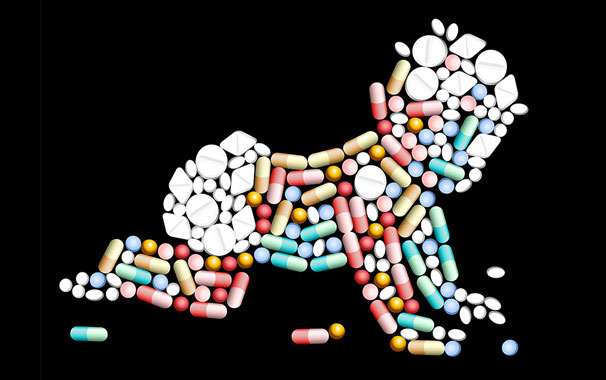
The rate of babies born with opioid dependency is soaring across the U.S., including a historic 15-fold rise in Arkansas. In a united force to raze the rates, multiple states sent representatives recently to a “Policy Academy” in Texas.

Termed Neonatal Abstinence Syndrome (NAS), babies exposed to opioids while in the mother’s womb, have a very high risk of enduring opioid withdraw symptoms and may have long-term health problems. Dr. Whit Hall, a neonatologist at the University of Arkansas for Medical Sciences, told KTHV 11 that NAS babies have to stay longer in the hospital, which often means more exposure to opioids.

Dr. Hall said that “Some of these babies, quite frankly, are going to come in dead,” but of those that survive “There’s no question that exposure to these drugs can affect the long term neurodevelopmental outcome of these infants.” [KTHV 11]

In 2000 the NAS rate in Arkansas was 0.3 per 1,000 births. By 2017, the NAS increased to 4.8 per 1,000 births. The median number of days spent in the hospital for NAS diagnosed newborns is 10, compared to 2 days for non-NAS newborns. Median medical care cost was $28,270 for NAS diagnosed newborns, compared to $4,446 for non-NAS newborns. [Arkansas Department of Health statistics]

“These alarming statistics are disheartening, but we are vigorously researching, discussing and sharing ideas, programs, and plans to combat this issue,” said Arkansas Drug Director Kirk Lane.

The Arkansas representatives – Lane, Ark. Dept. of Health officials, and Arkansas Medicaid personnel – joined numerous other state representatives in San Antonio in early March for a “Promoting Innovation in State Maternal & Child Health (MCH) Policymaking (PRISM) Policy Academy.” Lane said the purpose of the academy was multifaceted – to learn from subject matter experts, identify priorities, and develop state and territorial team action plans supporting policy implementation related to mental health and substance misuse and addiction for maternal and child populations.

Lane and other state representatives were invited to the PRISM Policy Academy by the Association of State & Territorial Health Officials (ASTHO) and the Association of Maternal & Child Health Programs (AMCHP) to join the PRISM Learning Community. According to Michael Fraser and Jonathan Webb, chief executive officers of ASTHO and AMCHP, respectively, the PRISM Learning Community, “will leverage national, state, and local-level expertise to support teams in developing and implementing policy initiatives that address substance misuse and addiction and mental health disorders in women, children, and families.”

“I’m excited to be a part of this PRISM program to reduce the rise of Neonatal Abstinence Syndrome in Arkansas and beyond,” Lane said. “The PRISM Academy and PRISM Learning Community will strengthen policies and other plans to dramatically reduce NAS and strengthen the health of our communities. It’s all about saving and protecting lives when you get to the heart of it.”

AMCHP and ASTHO will also partner with four national health associations to advance effective policy solutions on substance use and mental health disorders: National Association of State Alcohol and Drug Abuse Directors (NASADAD), National Association of County and City Health Officials (NACCHO), National Association of Medicaid Directors (NAMD) and National Organization of Urban Maternal & Child Health Leaders (CityMatCH).

The Arkansas team included representatives from the state’s Drug Director’s Office, Dept. of Health, & Arkansas Medicaid


Substance Abuse Awareness Week to Run March 11-15 Across Arkansas

For the first time ever, college and university students across the state of Arkansas are joining forces to combat substance abuse. The inaugural “Save AR Students” substance abuse awareness week will be held from March 11-15, 2019. A news conference will be held on the steps of the Arkansas State Capitol in Little Rock at 9 a.m. Monday, March 11.

The event was organized by student government association members from the University of Arkansas and 18 other state colleges and universities. Speakers at the news conference include Gov. Asa Hutchinson, Arkansas Drug Director Kirk Lane, Christopher Dickie, Kimberly Ashley-Pauley and Trevor Villines. In the event of inclement weather, the kickoff will be held at the Association of Arkansas Counties at 1415 W. 3rd St., Little Rock.

“It’s no secret that substance use is drastically affecting the state of Arkansas. It’s concerning that statistics have us towards the top for opioid prescriptions here in our state. It is very concerning seeing this issue affect our college campuses,” said Trevor Villines, a University of Arkansas, Fayetteville student who serves as Save AR Students 2019 Event Director.

According to the Centers for Disease Control, in 2017 Arkansas had the second-highest opioid prescription rate in the country – with more prescriptions written than the actual population of the state. According to the Substance Abuse and Mental Health Administration, people ages 18-25 have the highest risk for illicit drug use at a rate of 22.7 percent. 9.9% of college students abuse Adderall, compared to 6.2% of non-college adults according to drugabuse.org. Adderall, frequently prescribed to treat Attention Deficit-Hyperactivity Disorder (ADHD), has stimulant effects and can be physically and psychologically addictive when misused.

The initiative received support from prevention programs of Arkansas Department of Human Services/Division of Aging, Adult, and Behavioral Health Services and the Arkansas Drug Director’s Office. The Substance Abuse and Mental Health Administration of the U.S. Department of Health and Human Services has awarded several federal grants to the prevention unit, providing resources for this and other projects.

“Save AR Students 2019” participating institutions include: University of Arkansas- Fayetteville, Arkansas State University, Arkansas Tech University, University of Central Arkansas, Henderson State University, Southern Arkansas University, University of Arkansas- Fort Smith, University of Arkansas-Little Rock, University of Arkansas-Monticello, University of Arkansas-Pine Bluff, ASU-Mountain Home, University of Arkansas-Cossatot Community College, East Arkansas Community College, Northwest Arkansas Community College, University of Arkansas-Phillips Community College, University of Arkansas Community College at Batesville, University of Arkansas Community College at Hope, University of Arkansas at Rich Mountain, and University of Arkansas Pulaski Technical College. The Associated Student Government at the University of Arkansas-Fayetteville collaborated with Student Government Associations and Student Activity Representatives at each campus to make this event possible.

Each campus will determine its own schedule and activities.

The University of Arkansas Fayetteville Associated Student Government is joining with Pat Walker and several campus organizations to promote the week and raise awareness of substance abuse. Throughout the week volunteers will be tabling from 11 a.m. to 2 p.m.at the Student Union distributing information on prescription opioids, heroin, fentanyl, amphetamines, and Arkansas’s Joshua-Ashley-Pauley Act, and giving away buttons and t-shirts promoting the Save AR Students.

Other events during the week at the Fayetteville campus include:

  • A presentation by the Arkansas Department of Health at 6 p.m. Tuesday, March 12, in the Graduate Education Building Auditorium.
  • A panel discussion at 11:30 a.m. Wednesday, March 13, in Reynolds Auditorium.
  • A Narcan training session at 5 p.m. Wednesday, March 13, in the foyer of the Graduate Education Building Auditorium.

“Substance abuse has no borders,” Villines said. “It affects people of different gender, race, and religion. If we’re going to do something about it, the time is now. We’ve got to roll up our sleeves, put politics aside, and come together as one. It’s up to us to Save AR State, Save AR Future, but more importantly, Save AR Students.”

For more information, contact:

Save AR Students 2019
Event Director: Trevor Villines
ASG Director of External Relations
501-672-8515
[email protected]

DEA ANNOUNCES ENHANCED TOOL FOR REGISTERED DRUG MANUFACTURERS AND DISTRIBUTORS TO COMBAT OPIOID CRISIS

WASHINGTON – The Drug Enforcement Administration (DEA) announces the launch of an enhanced system to help more than 1,500 registered drug manufacturers and distributors nationwide more effectively identify potential illicit drug diversion and combat the opioid epidemic.

On Oct. 24, 2018, President Trump signed into law the “Substance Use–Disorder Prevention that Promotes Opioid Recovery and Treatment for Patients and Communities Act,” or the “SUPPORT for Patients and Communities Act” (Public Law 115-217). A provision in the bill amends 21 U.S.C. 827, requiring the Drug Enforcement Administration to provide drug manufacturers and distributors with access to anonymized information through the Automated Reports and Consolidated Orders System (ARCOS) to help drug manufacturers and distributors identify, report, and stop suspicious orders of opioids and reduce diversion rates.

ARCOS is a comprehensive drug reporting system that monitors the distribution of controlled substances from the point of manufacture through commercial drug supply chain channels to the point of sale to the retail level (e.g., practitioners, pharmacies, hospitals/clinics). ARCOS does not contain or collect any data on sales to ultimate users (i.e., patients).

In February 2018, DEA launched a new tool in its ARCOS Online Reporting System to assist drug manufacturers and distributors with their regulatory obligations under the Controlled Substances Act.  The new statutory requirement in the SUPPORT Act builds upon this existing tool and DEA is releasing a further enhancement to its ARCOS Online Reporting System. The enhancement will allow DEA-registered manufacturers and distributors to view and download the number of distributors and the amount (anonymized data in both grams and dosage units) each distributor sold to a prospective customer in the last available six months of data. This resource is one of many steps DEA is taking to collaborate with its 1.8 million registrants to combat the ongoing opioid epidemic in the United States.

DEA regulations require distributors to both know their customers and develop a system to identify and report suspicious orders. Manufacturers and distributors have consistently expressed a desire for assistance from DEA in fulfilling these obligations and have requested ARCOS information to help them make informed decisions about whether new customers are purchasing excessive quantities of controlled substances. This new tool will provide valuable information for distributors to consider as part of their assessment. For example, if a query resulted in a large number of suppliers who have recently sold unusual quantities of opioid analgesics to a prospective purchaser, this may represent a “red flag” to the new distributor and foster a dialogue between that distributor and the pharmacy.

Life Saving Efforts Underway: $150,000 Grant Leads to 1,390 Naloxone Kits for 1st Responders

Funding from Blue & You Foundation for a Healthier Arkansas Continues to Expand Availability and Usage of Naloxone to Reduce Overdose Deaths in the State

February 21, 2019, Little Rock, AR— Through a $150,000 grant provided by the Blue & You Foundation for a Healthier Arkansas, efforts are underway at the Criminal Justice Institute (CJI) to continue expanding the availability and usage of naloxone by providing kits containing this lifesaving drug to 1,390 Arkansas first responders. Naloxone is a nasal spray that can reverse an opioid drug overdose if administered in time and followed up appropriately.

“We are so grateful to the Blue & You Foundation for a Healthier Arkansas for their continued investment in this program,” said CJI Director Dr. Cheryl May. “Too many families in Arkansas have experienced the loss of a loved one due to an opioid overdose. By equipping first responders with naloxone, additional lives can be saved and families can be spared this loss.”

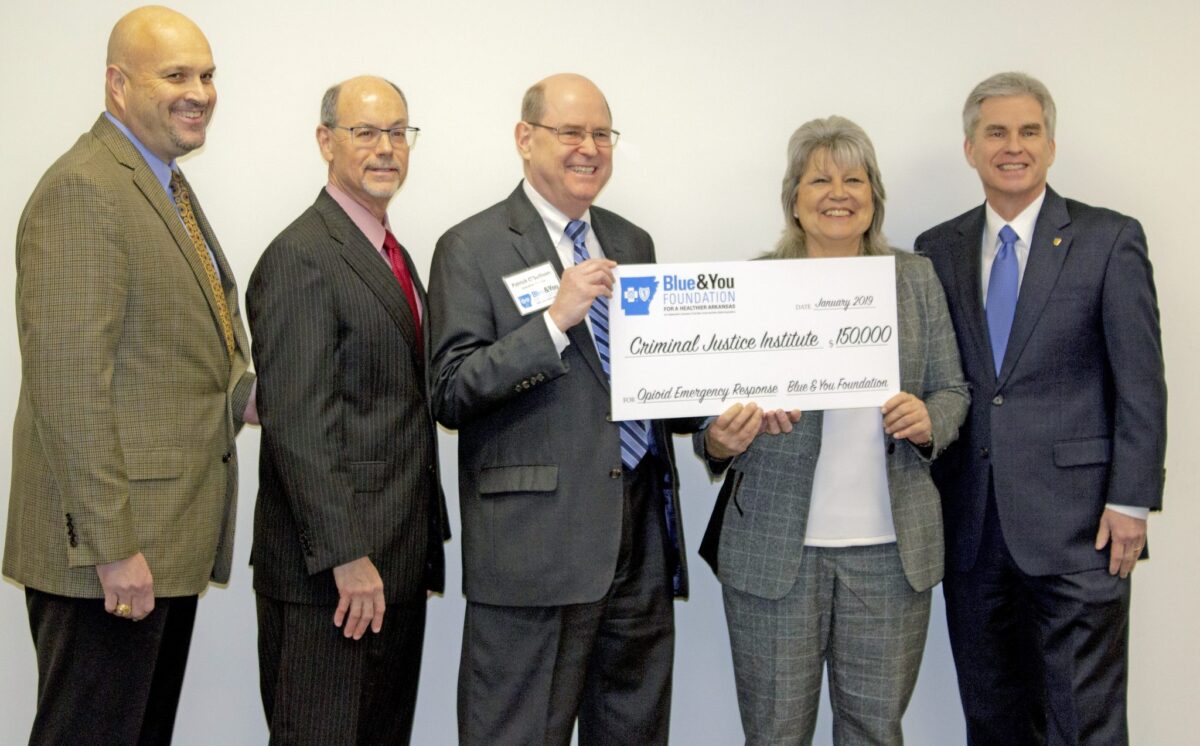
On Friday, Feb. 22, 2019, Curtis Barnett, President and CEO of Arkansas Blue Cross and Blue Shield, and Patrick O’Sullivan, Executive Director of the Blue & You Foundation for a Healthier Arkansas, & the University of Arkansas System President Dr. Donald R. Bobbitt presented a ceremonial check to Dr. May and Arkansas Drug Director Kirk Lane.

“Through the efforts of the Blue & You Foundation, Criminal Justice Institute, and other partnerships, many lives will be saved throughout the state,” said Lane. “It is important to understand that when a life is saved by the use of a Naloxone kit – If they are alive, there is a chance of recovery. We have met several of these saved individuals, and members of their family, and found that they are now in the process of going through recovery treatment because of these events.”

This grant program will expand the number of first responders capable of saving a life with naloxone. Currently, more than 200 lives have been saved in Arkansas with the administration of this nasal spray.

“Thousands of Arkansans have been affected by opioid addiction but those numbers don’t begin to tell the story of the devastation this crisis has had on the lives of real people and real families,” said Curtis Barnett. “At Arkansas Blue Cross, we believe it’s important to connect people to treatment and resources to help fight opioid abuse, and an important part of that work is to make naloxone more accessible.  The Blue & You Foundation for a Healthier Arkansas is proud once again to support the University of Arkansas Criminal Justice Institute and state drug director Kirk Lane as we expand the availability of naloxone kits to even more of our local law enforcement agencies to help them to continue to save lives.”

Through this grant program, at least thirty-five (35) municipal, campus, county and state law enforcement and first responder agencies will receive naloxone kits. Each kit consists of two 4mg doses of naloxone, nitrile gloves, a CPR face shield, hand sanitizer, drug treatment information, and a carrier. Equipped with these kits, law enforcement and other first responders can more effectively respond to opioid overdoses, potentially preventing overdose deaths.

Prior to receiving naloxone kits, participating agencies must execute a Memorandum of Understanding (MOU) with a medical director in their community and implement a model department policy regarding naloxone administration. Each first responder receiving a naloxone kit must also complete a two-hour online training through the Criminal Justice Institute demonstrating the proper use of naloxone.

ABOUT THE BLUE & YOU FOUNDATION

Arkansas Blue Cross and Blue Shield established the Blue & You Foundation in 2001 as a charitable foundation to promote better health in Arkansas. The Blue & You Foundation awards grants annually to non-profit or governmental organizations and programs that positively affect the health of Arkansans. In its 17 years of operation, the Blue & You Foundation has awarded more than $33 million to 1,566 health improvement programs in Arkansas.

ABOUT THE CRIMINAL JUSTICE INSTITUTE

The Criminal Justice Institute (CJI) is a division of the University of Arkansas System that provides programs and services designed to enhance proficiency and professionalism within the Arkansas law enforcement community. CJI delivers advanced training in progressive areas of criminal justice, including law enforcement leadership and management, forensic sciences, computer technologies, illicit drug investigations, and school, traffic, and officer safety. By providing these services, CJI assists law enforcement agencies in positively impacting not only public safety, but also the economic viability of communities across the State.